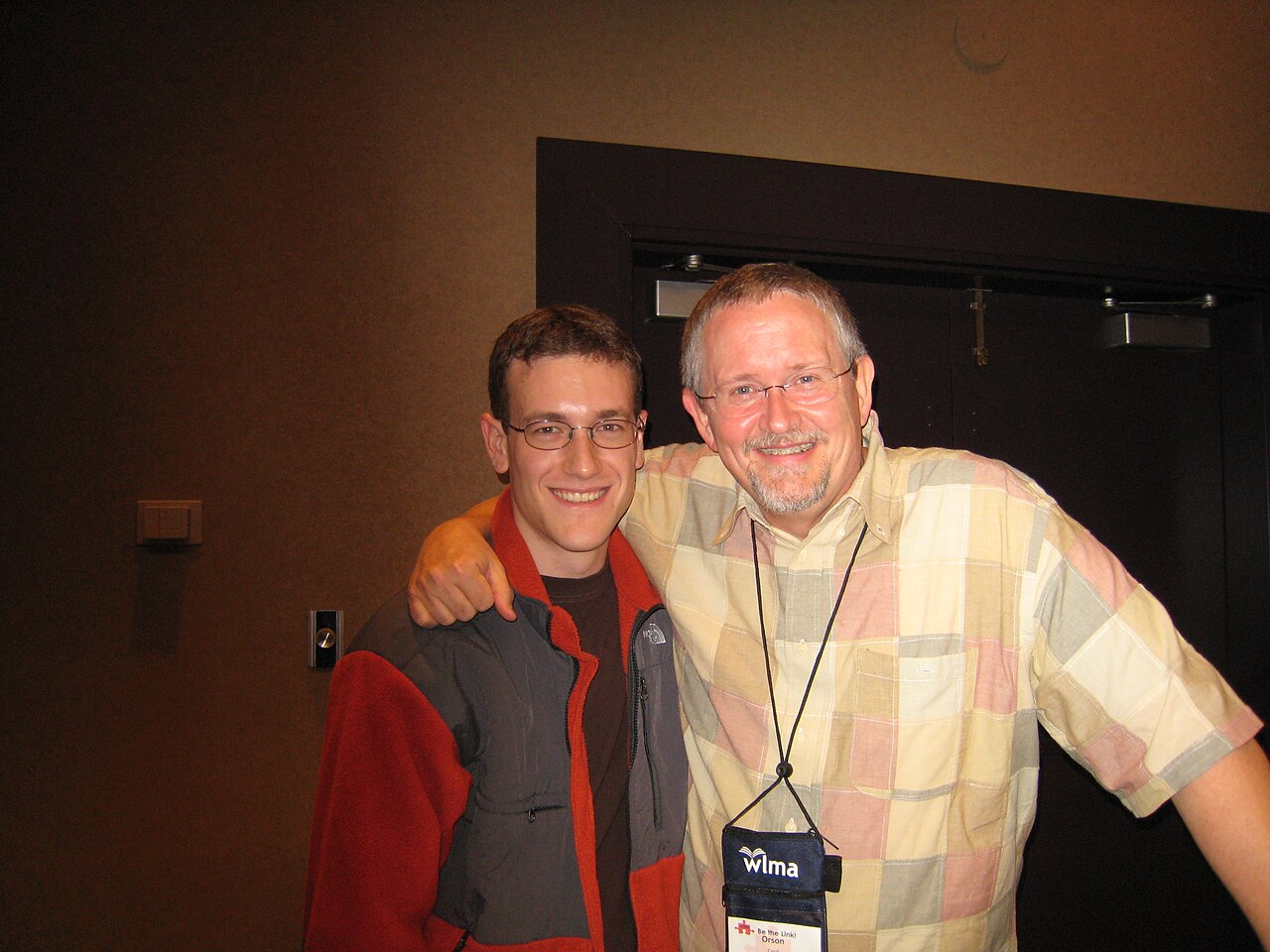
Orson Scott Card
Only writer to win Hugo and Nebula Awards in consecutive years.

Jeremy Hall · CC BY 2.0
Orson Scott Card (born August 24, 1951) is an American writer best known for his science fiction works, particularly the novel Ender's Game and its sequel Speaker for the Dead. As of 2024, he is the only person to have won both the Hugo Award and the Nebula Award in consecutive years, achieving this for those two novels. Card has also written fantasy, historical fiction, nonfiction, and political and religious commentary, and has taught creative writing.
- born
- August 24, 1951, Richland, Washington
- field
- Writer (science fiction, fantasy, historical fiction, nonfiction)
- nationality
- American
- known_for
- Ender's Game (1985) and Speaker for the Dead (1986), winning Hugo and Nebula Awards in consecutive years; The Tales of Alvin Maker series
Lore & Background
Orson Scott Card was born in Richland, Washington, to Peggy Jane and Willard Richards Card, the third of six children. He is a great-great-grandson of Brigham Young. His family moved frequently during his childhood, living in California, Utah, and Arizona. He attended Brigham Young University (BYU), where his plays were performed on stage, and served as a missionary for the Church of Jesus Christ of Latter-day Saints in Brazil. He earned a bachelor's degree in theater from BYU in 1975 and a master's degree in English from the University of Utah in 1981.
Card began publishing short stories in 1977, with his first science fiction story "Ender's Game" appearing in Analog that year. He won the John W. Campbell Award for Best New Writer in 1978. His novel Ender's Game (1985) and its sequel Speaker for the Dead (1986) both won Hugo and Nebula Awards, making him the only person to achieve this in consecutive years. He also wrote the Locus Fantasy Award-winning series The Tales of Alvin Maker (1987–2026). Card has published over 50 novels and 45 short stories, and a feature film adaptation of Ender's Game, which he co-produced, was released in 2013.
Card married Kristine Allen in 1977; they have five children, two of whom predeceased them. He has taught English at Southern Virginia University, written two books on creative writing, and served as a judge in the Writers of the Future contest. Card has also written political, religious, and social commentary, and has provoked controversy for his public opposition to homosexuality.
Reader's Guide
Orson Scott Card's significance lies primarily in his science fiction achievements, most notably being the only writer to win both the Hugo and Nebula Awards in consecutive years for Ender's Game and Speaker for the Dead. These works, along with his Locus Fantasy Award-winning Tales of Alvin Maker series, established him as a major figure in speculative fiction. His fiction often features characters with exceptional gifts who make difficult choices with high stakes. Beyond his novels, Card has been influential as a teacher of creative writing, holding literary boot camps and teaching at Southern Virginia University. His career also includes extensive work in audio plays on LDS Church history and editing anthologies. However, his public opposition to homosexuality has generated significant controversy and criticism, shaping his legacy as a polarizing figure. His body of work spans multiple genres, including science fiction, fantasy, historical fiction, and nonfiction, and he has published over 50 novels and 45 short stories as of the source article's coverage.
Did You Know?
- Card is the only person to have won both the Hugo Award and the Nebula Award in consecutive years, for Ender's Game (1985) and Speaker for the Dead (1986).
- He is a great-great-grandson of Brigham Young.
- Card served as a missionary for the LDS Church in Brazil.
- He suffered a mild stroke on January 1, 2011, and made a full recovery.
A Vast and Varied Bibliography
Orson Scott Card's published output stretches across an extraordinary range of series and standalone works, making his bibliography one of the most extensive in speculative fiction. His catalog includes major multi-book sagas such as Ender's Game, the Tales of Alvin Maker, the Homecoming Saga, Women of Genesis, Pastwatch, Mithermages, the Worthing series, the Empire series, Pathfinder, Laddertop, Side Step, and Micropowers. Beyond these long-running series, he has produced standalone novels, short story collections, and anthologies that he personally edited. His reach extends well past traditional fiction: he has written plays, non-fiction works, books dedicated to the craft of writing, and recurring columns. His stories have also been adapted into other media, and his work has been published through major houses including Macmillan and Marvel. This sheer volume and variety—spanning science fiction, fantasy, historical fiction, and religious-themed storytelling—reflects a career defined by relentless productivity and an unwillingness to confine himself to a single genre or format.
The Mayflower Trilogy and a Collaboration Cut Short
In 1994, Orson Scott Card embarked on a collaborative project called Mayflower, envisioned as a trilogy co-written with Kathryn H. Kidd. The partnership was meant to produce three volumes, yet only a single book in the planned series ever reached publication. The project thus remained unfinished, a truncated ambition in an otherwise prolific career. Kathryn H. Kidd passed away in 2015, a loss that left the remaining volumes unfulfilled. The Mayflower project stands as a notable exception in Card's bibliography: unlike his many other series, which he developed and sustained over long stretches of time, this one was a joint venture that never fulfilled its original scope. It also highlights a dimension of his career less often discussed—the willingness to share the creative process with a writing partner. The incomplete nature of the trilogy, combined with Kidd's death, gives the project a poignant, unfinished quality that distinguishes it from the rest of his substantial body of work.
Seven Names, One Writer: The Pseudonym Practice
Throughout his career, Orson Scott Card adopted at least seven different pen names, each serving a specific practical purpose. He used the name Gert Fram because he already had three other pieces appearing in the same issue of a publication. The pen name Byron Walley appeared in various LDS magazines, including the Friend and the New Era, and also in the short story "Middle Woman" published in Dragons of Darkness. For a Spring 1976 article in Sunstone magazine surveying Mormon playwrights, he wrote under both Frederick Bliss and P.Q. Gump, explaining that the piece contained a brief self-reference and a mention of his play "Stone Tables." In July 1977, he submitted the short play "The Rag Mission" to Ensign magazine under the name Brian Green, again because three of his other works were running in that same issue. Finally, the October 1989 issue of The Green Pages carried his short story "Damn Fine Novel" under the name Noam D. Pellume. This pattern reveals a writer who was acutely aware of editorial logistics and reader perception.
Archives, Awards, and Life Beyond the Page
The full scope of Orson Scott Card's creative life is preserved in the Orson Scott Card papers, cataloged as MSS 1756 at the L. Tom Perry Special Collections at Brigham Young University. This archive holds his published works alongside personal writing notes and letters, offering researchers a window into the process behind the finished text. His career has been recognized with science fiction award wins and nominations, and his published works are distributed through major platforms including Macmillan.com and Marvel.com. Beyond the novels and series that define his public identity, Card has produced plays, non-fiction, books on the craft of writing, and recurring columns. His connection to the LDS publishing world is evident in his contributions to magazines such as the Friend, the New Era, Ensign, and Sunstone, where he wrote under multiple pseudonyms. Together, these elements—archival materials, award recognition, cross-platform publication, and a deep engagement with religious and literary communities—paint a portrait of a writer whose influence extends far beyond any single genre.
Gallery




More in Science Fiction And Fantasy Writers 1-19
Spotted an error? Know more?
This is a living reference — every entry is fact-audited, and reader corrections feed straight into our audit queue. Suggest an edit · See this site's audit record